
7 Best Exercises for Lower Back Pain
A stiff lower back can change the whole rhythm of your day. Getting out of bed feels cautious, sitting through work feels longer than it should, and even simple tasks like tying your shoes can become reminders that something is off. When patients ask about the best exercises for lower back pain, the right answer is usually not the hardest workout or the most popular stretch online. It is the movement that matches the cause of the pain, supports healing, and helps you return to normal activity without making symptoms worse.
What makes the best exercises for lower back pain effective?
Lower back pain is not one single condition. For one person, it may come from muscle strain after lifting. For another, it may be related to poor hip mobility, spinal arthritis, disc irritation, or deconditioning after weeks of reduced activity. That is why the best exercises for lower back pain tend to share a few qualities rather than follow a one-size-fits-all formula.
They improve mobility where the body is too stiff, build support where the core and hips are too weak, and reduce stress on irritated tissues. Most importantly, they are tolerable. Mild pulling or muscular effort can be normal, but sharp, radiating, or escalating pain is a sign to stop and reassess.
In a clinical setting, we often look at how a patient moves before recommending exercises. Some people need more flexibility. Others need stability and motor control. Many need both. That balance matters, because stretching an already unstable back or loading a highly inflamed area too early can delay recovery instead of helping it.
7 best exercises for lower back pain
1. Pelvic tilts
Pelvic tilts are simple, but they are often one of the most useful starting points for people whose back feels tight, guarded, or sore after inactivity. Lie on your back with your knees bent and feet flat. Gently flatten your lower back toward the floor by tightening your abdominal muscles and tipping your pelvis slightly. Hold for a few seconds, then relax.
This exercise helps improve awareness of spinal position and engages the deep abdominal muscles without much strain. It is especially helpful for people who feel discomfort with prolonged sitting or first thing in the morning.
2. Knee-to-chest stretch
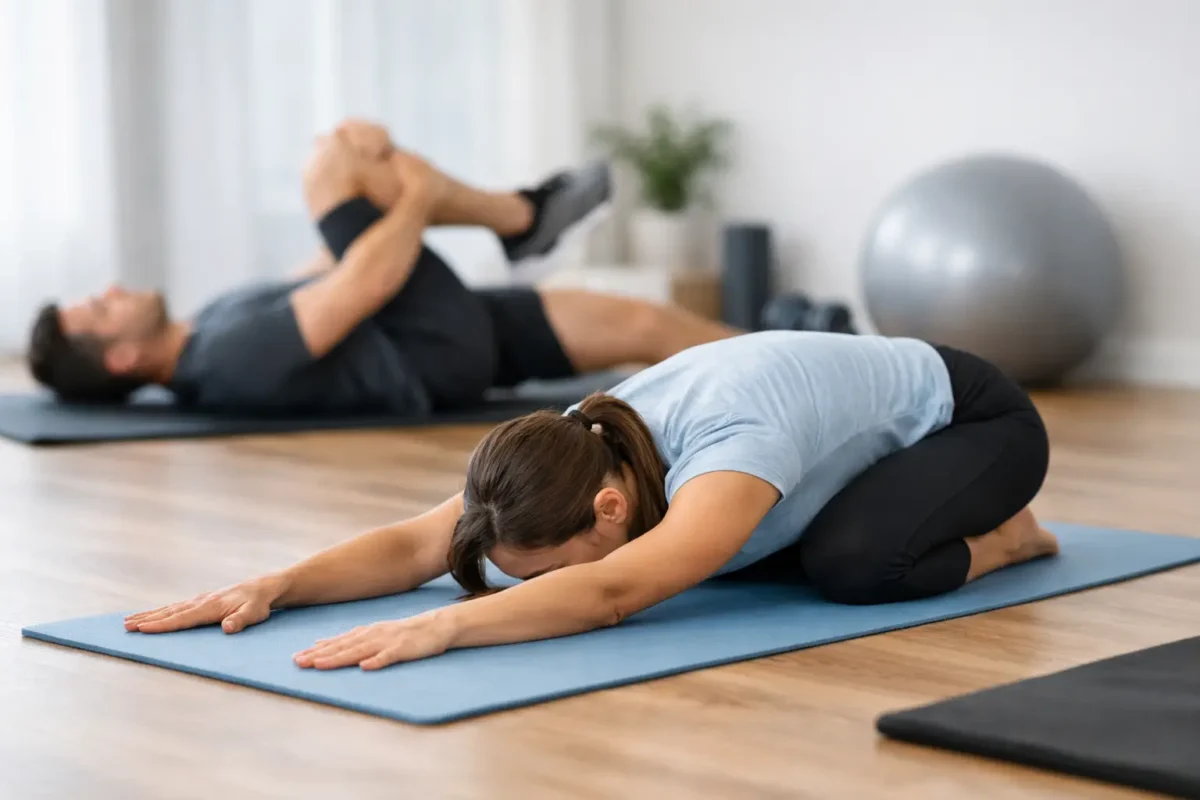
For some patients, a gentle flexion-based stretch can ease tension in the lower back and hips. While lying on your back, bring one knee toward your chest and hold it with both hands. Keep the other foot flat or the leg extended, depending on comfort. After several breaths, switch sides.
This movement can reduce stiffness and provide short-term relief, particularly when tight muscles are contributing to discomfort. It is not ideal for everyone, though. If bending forward worsens your pain or increases symptoms into the leg, this may not be your best option.
3. Cat-cow movement
This controlled spinal motion is useful for many people who need gentle mobility rather than aggressive stretching. Start on your hands and knees. Slowly round your back upward, then reverse the motion by lifting your chest and tailbone slightly. Move within a comfortable range.
Cat-cow encourages circulation, reduces stiffness, and helps patients reconnect with movement after pain has made them hesitant. The key is slow, easy motion. Pushing to the end of range usually adds little benefit.
4. Bird-dog
Bird-dog is one of the best exercises for lower back pain when the goal is stability. Begin on your hands and knees with your spine in a neutral position. Extend one arm forward and the opposite leg backward without letting your lower back arch or your hips rotate. Return to start and alternate sides.
This exercise trains the muscles that support the spine during daily activities like walking, lifting, and reaching. It also improves coordination. If the full version feels unsteady, start by moving only the arm or only the leg.
5. Glute bridges
The lower back often works too hard when the hips and glutes are not doing their share. Glute bridges help correct that pattern. Lie on your back with knees bent and feet hip-width apart. Tighten your glutes and lift your hips until your shoulders, hips, and knees form a gentle line. Pause, then lower slowly.
Bridges strengthen the posterior chain and reduce unnecessary strain on the lumbar spine. They are often valuable for people who sit for long periods, have weak hips, or feel back discomfort during standing and walking.
6. Child’s pose with modification
This stretch can be soothing for some patients, especially when the back feels compressed or fatigued. From a hands-and-knees position, sit your hips back toward your heels and reach your arms forward. If full flexion is uncomfortable, widen your knees, place a pillow under your hips, or reduce the depth.
As with knee-to-chest stretching, this depends on the pattern of pain. Some people feel immediate relief. Others with disc-related pain may not tolerate it well. Comfort should guide the range.
7. Walking
It may not look like a traditional exercise, but walking is one of the most reliable ways to help many forms of lower back pain. It promotes circulation, keeps joints moving, and encourages the spine and hips to work together naturally. For patients recovering from flare-ups, short and frequent walks are often more helpful than one long session.
If walking increases pain significantly, causes leg weakness, or brings on numbness, that deserves closer evaluation. But for many adults, a consistent walking routine is a practical part of recovery.
How to choose the right exercise for your symptoms
The best plan depends on how your back pain behaves. If stiffness and soreness improve once you start moving, gentle mobility work and walking may be a good fit. If your back feels unstable, fatigues easily, or flares during lifting, stabilization exercises like bird-dog and bridges may be more useful.
Pain that travels into the buttock or leg needs more caution. Sometimes that pattern responds well to guided exercise, but the exact direction of movement matters. In those cases, guessing from a video or trying random stretches can be frustrating. The same exercise that helps one patient may aggravate another.
A good rule is to look for movements that either reduce your symptoms or leave you feeling looser and more supported afterward. If pain sharply increases during the exercise, lingers at a higher level, or begins radiating farther, stop that movement.
A few mistakes that can keep back pain going
Many people do too much too soon. When the back starts to feel better, it is tempting to jump into intense stretching, abdominal workouts, or high-impact exercise. That can irritate healing tissues and restart the cycle.
Another common issue is focusing only on the painful area. The lower back is strongly influenced by hip mobility, glute strength, posture, and movement mechanics. If those factors are ignored, the pain may keep returning.
Form also matters more than intensity. A small, controlled bridge or bird-dog usually provides more benefit than a larger, rushed version that causes the back to compensate.
When exercise is not enough
Exercise is a powerful tool, but it is not the only answer. If pain has lasted more than a few weeks, keeps returning, or limits work, sleep, driving, or normal activity, it makes sense to have it evaluated. The same is true if you notice numbness, tingling, leg weakness, balance changes, or pain after a car accident or fall.
Coordinated care can make a major difference here. Instead of bouncing between separate offices, patients often do better when physical rehabilitation, pain management, diagnostic evaluation, and specialist input are working from the same plan. At Denville Medical Associates, that integrated approach helps patients move from diagnosis to conservative treatment and recovery with less confusion and better continuity.
When to seek prompt medical attention
Some back pain symptoms should not wait. Seek medical care promptly if you have loss of bowel or bladder control, severe or worsening weakness in the legs, fever with back pain, unexplained weight loss, or significant pain after trauma. Those situations may point to something more serious than a routine mechanical strain.
For everyone else, the goal is not to chase a perfect exercise list. It is to find the movements your body can tolerate, perform them consistently, and adjust the plan when your symptoms suggest you need more support. Relief often starts with small, well-chosen steps that help you move with more confidence again.