
Guide to EMG Nerve Testing and What to Expect
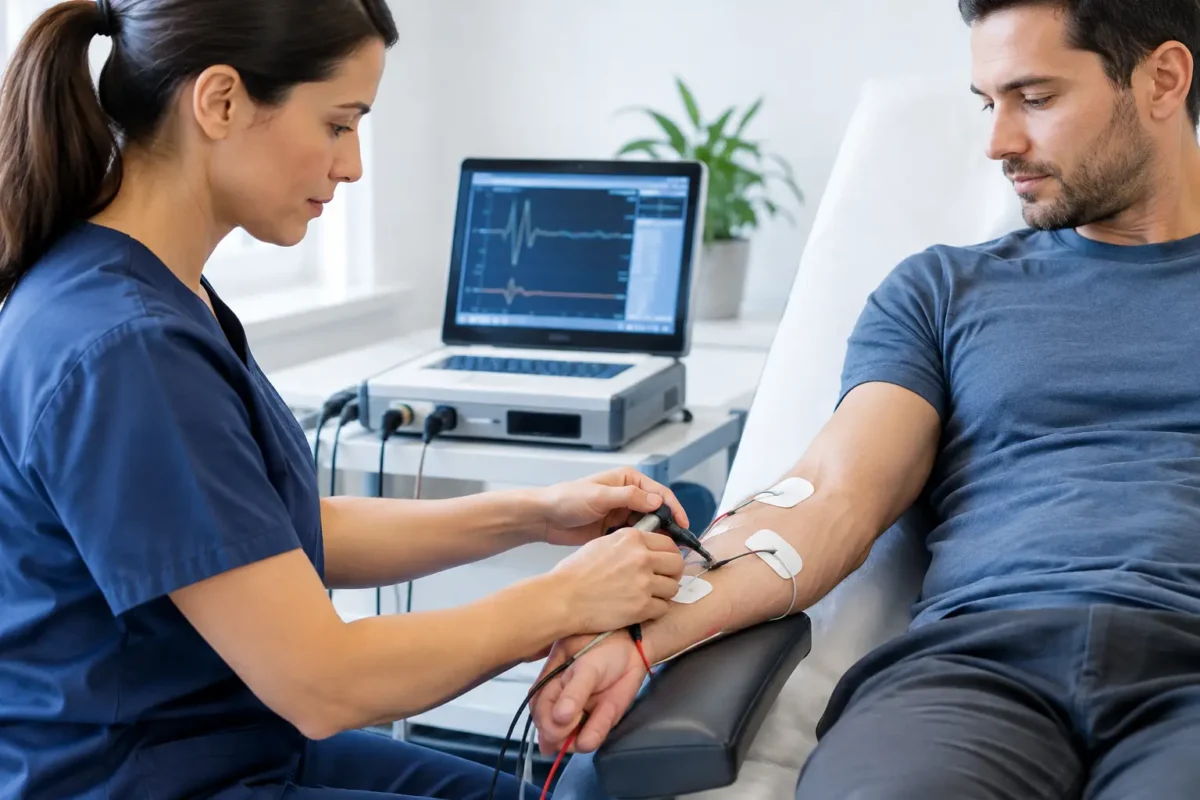
A hand that keeps tingling at night, a foot that feels weak on the stairs, or pain that travels from the neck or low back into an arm or leg can have several possible causes. A guide to EMG nerve testing can help you understand one of the tools physicians use to identify whether symptoms are coming from a nerve, a muscle, or the spine. The test provides useful clinical information, but it is only one part of a complete evaluation that also considers your symptoms, exam findings, imaging, medical history, and recovery goals.
What Is EMG Nerve Testing?
The phrase “EMG nerve testing” commonly refers to two tests performed together: electromyography, or EMG, and a nerve conduction study, often called NCS. They assess how well nerves send electrical signals and how muscles respond to those signals.
A nerve conduction study measures the speed and strength of electrical signals traveling through a nerve. Small surface electrodes are placed on the skin, and brief electrical impulses stimulate the nerve. The response can help show whether a nerve is compressed, irritated, injured, or functioning normally.
During an EMG, a physician places a very fine needle electrode into selected muscles. The electrode records the muscle’s electrical activity while the muscle is resting and while you gently contract it. This helps identify patterns that may point to a nerve root problem in the spine, a peripheral nerve injury, or a primary muscle condition.
Despite the common wording, the test does not “read” pain directly. It measures nerve and muscle function. Normal findings can still be meaningful, because they can help narrow the list of possible causes and guide the next step in care.
Why Your Physician May Recommend an EMG
EMG and nerve conduction testing may be recommended when symptoms suggest that a nerve is not communicating normally with a muscle. Common concerns include persistent numbness, burning, tingling, cramping, weakness, loss of grip strength, foot drop, or radiating pain.
For example, tingling in the thumb, index finger, and middle finger may raise concern for carpal tunnel syndrome. Pain running from the low back into the leg may be related to a lumbar nerve root, sometimes called sciatica. Numbness in the feet may require evaluation for peripheral neuropathy. Similar symptoms can overlap, which is why testing can be helpful when the diagnosis is not clear from an exam alone.
The test may help evaluate conditions such as carpal tunnel syndrome, ulnar neuropathy at the elbow, cervical or lumbar radiculopathy, peripheral neuropathy, plexus injuries, and certain muscle disorders. It may also help determine the location and severity of a known nerve injury and whether there are signs of recovery.
However, timing matters. In some recent injuries, changes may not appear immediately. Your physician may recommend waiting a period of time before testing or repeating a study later, depending on the suspected condition and the progression of symptoms.
A Guide to EMG Nerve Testing: What Happens During the Visit
Most EMG appointments take about 30 to 60 minutes, although the length depends on how many areas need evaluation. You will generally sit or lie comfortably while the clinician tests the nerves and muscles relevant to your symptoms.
The nerve conduction portion usually comes first. Your skin may be cleaned, then electrodes are positioned over specific nerves and muscles. You will feel quick, controlled electrical pulses. Many patients describe them as a brief tapping, buzzing, or snapping sensation. The intensity is adjusted to obtain accurate information, but each stimulation lasts only a moment.
For the needle EMG portion, the physician uses a sterile, single-use needle electrode in selected muscles. You may feel a quick pinch when the needle enters, followed by mild pressure or an ache as you are asked to relax or gently move the muscle. The needle does not inject medication or electricity into the muscle. It records electrical activity.
The clinician may test both sides of the body, even if your symptoms are only on one side. Comparing sides can help distinguish a normal variation from a meaningful abnormality. Communication matters during the test. Tell the clinician if you are uncomfortable, lightheaded, or need to change position.
How to Prepare for an EMG
Preparation is straightforward, and it helps produce reliable results. On the day of your appointment, bathe or shower as usual but avoid applying lotion, oils, creams, or sunscreen to the areas being tested. These products can interfere with electrode contact.
Wear loose, comfortable clothing that allows access to the affected arm, leg, neck, or back. You may be asked to change into a gown depending on the testing area. Continue medications unless your treating clinician gives you different instructions.
Before testing, report all medications and health conditions, especially if you take blood thinners, have a bleeding disorder, have a pacemaker or implanted electrical device, are pregnant, or have a skin infection or open wound near the test area. These factors do not automatically prevent testing, but they may change how the study is planned or whether part of it should be postponed.
It is also helpful to bring prior imaging reports, surgery information, and a clear description of when symptoms began. Let the clinician know whether symptoms are constant or intermittent, what triggers them, and whether you have noticed progressive weakness. Those details help ensure the test addresses the right clinical question.
Does EMG Testing Hurt?
Most patients find EMG nerve testing tolerable. The nerve conduction portion can be startling because of the quick electrical pulse, but it is brief. The needle portion may cause short-lived discomfort similar to a pinprick or a deep muscle ache.
Afterward, it is common to have mild soreness or small bruises where muscles were tested. This usually resolves within a day or two. Normal activity can generally resume right away, although you may prefer to avoid strenuous use of a sore muscle until it feels comfortable.
Serious complications are uncommon when testing is performed by a qualified clinician. Contact your medical team promptly if you develop increasing redness, swelling, significant bleeding, fever, or worsening pain at a needle site.
Understanding Your Results
Some preliminary observations may be discussed after the test, but a complete interpretation requires careful review of the recordings in the context of your examination and medical history. An abnormal result may show slowed nerve conduction, reduced signal strength, electrical changes in a muscle, or a pattern consistent with irritation at a nerve root.
A result does not always identify a single cause on its own. For instance, someone may have both age-related changes in the spine and carpal tunnel syndrome. A test can help clarify which finding best matches the symptoms that are limiting daily life.
Results also do not automatically mean surgery is needed. Many nerve and spine conditions respond well to conservative care, which may include activity modification, physical therapy, targeted rehabilitation, medication management, ergonomic changes, bracing, or carefully selected interventional treatments. If a result suggests severe compression, progressive weakness, or significant nerve injury, timely specialist evaluation may be appropriate.
At Denville Medical Associates, EMG findings can be considered alongside spine, pain management, rehabilitation, sports medicine, and surgical expertise in one coordinated setting. That continuity helps turn a test result into a practical, individualized treatment plan rather than leaving you to coordinate separate appointments on your own.
Common Questions About EMG Nerve Testing
Can I drive myself home after an EMG?
In most cases, yes. EMG testing does not involve sedation, and patients can usually drive and return to work or normal routines afterward. If pain, weakness, or another condition already makes driving unsafe, arrange transportation as you normally would.
Can an EMG find a pinched nerve?
It can provide evidence of nerve root irritation or injury, including patterns associated with a pinched nerve in the neck or low back. It cannot replace a physical examination or imaging when imaging is needed. The most useful answer comes from matching all of the available information.
What if my EMG is normal but I still have symptoms?
A normal test does not mean your symptoms are imagined or unimportant. Some conditions do not produce measurable changes on EMG, symptoms may be intermittent, or the affected nerve fibers may not be assessed by the study. Your clinician can use the result to consider other causes and determine the next appropriate step.
Persistent numbness, new weakness, balance problems, or pain that interferes with work, sleep, or movement deserves a clear evaluation. An EMG may be one useful piece of that process, helping you and your care team move from uncertainty toward treatment that supports safer movement and lasting recovery.