
Best Diagnostic Tests for Neuropathy Explained
Numb toes that gradually become painful, a burning sensation in the feet at night, unexpected weakness in the hands, or poor balance can all point to neuropathy. The best diagnostic tests for neuropathy are not one-size-fits-all. The right evaluation identifies which nerves are affected, how severely they are affected, and, just as importantly, what may be causing the problem.
For patients, a clear diagnosis can replace uncertainty with a practical care plan. Some causes of neuropathy can be improved or stabilized when recognized early, while others require ongoing symptom management and rehabilitation to protect mobility, sleep, and daily function.
Why neuropathy requires a careful evaluation
Peripheral neuropathy occurs when nerves outside the brain and spinal cord are damaged or not functioning normally. These nerves carry sensation, control muscle movement, and help regulate automatic functions such as sweating, blood pressure, and digestion. Because several types of nerves can be involved, symptoms vary considerably from person to person.
Diabetes is a common cause, but it is far from the only one. Vitamin deficiencies, thyroid conditions, kidney disease, alcohol use, certain medications, autoimmune conditions, infections, inherited disorders, and nerve compression can all contribute. In some cases, no cause is identified even after a thorough workup.
Symptoms also can resemble problems originating in the spine. For example, a pinched nerve in the lower back may cause tingling or weakness in one leg, while generalized peripheral neuropathy more often begins in both feet and progresses upward. A thoughtful examination helps distinguish these patterns so treatment targets the actual source of symptoms.
The first and most valuable test: a clinical examination
Before ordering specialized studies, a clinician should take a detailed history and perform a focused neurologic and musculoskeletal examination. This is often the most informative step because it shapes every test that follows.
Your provider may ask when symptoms began, whether they are worsening, what makes them better or worse, and whether they began after an illness, injury, medication change, or period of heavy alcohol use. A family history of similar symptoms can matter as well. Be prepared to discuss medical conditions, current supplements and medications, work exposures, and changes in weight, diet, or activity.
During the examination, the clinician may test reflexes, strength, walking pattern, coordination, vibration sense, light touch, temperature sensation, and the ability to feel a pinprick. They may check whether symptoms follow a stocking-and-glove distribution, a single nerve pathway, or a nerve root leaving the spine.
This assessment may sound simple, but it prevents unnecessary testing. A patient with isolated wrist numbness may need evaluation for carpal tunnel syndrome, while someone with symmetrical burning feet and reduced ankle reflexes may need a broader neuropathy workup.
Blood tests that look for treatable causes
Laboratory testing is commonly part of the initial evaluation. Blood work does not directly show nerve damage, but it can uncover medical conditions that may be driving it.
Depending on your symptoms and history, testing may include blood glucose and A1C levels for diabetes or prediabetes; vitamin B12 and sometimes folate levels; thyroid function; kidney and liver function; a complete blood count; and markers of inflammation. Clinicians may also order tests for abnormal blood proteins, autoimmune disease, infections, or nutritional deficiencies when the pattern of symptoms suggests those possibilities.
The trade-off is that broad testing without a clinical reason can create confusing results and additional expense. A targeted panel based on the examination is usually more useful than ordering every possible test at once. If a deficiency or metabolic issue is found, treating the underlying condition may help prevent further nerve injury, even when symptom improvement is gradual.
Nerve conduction studies and EMG
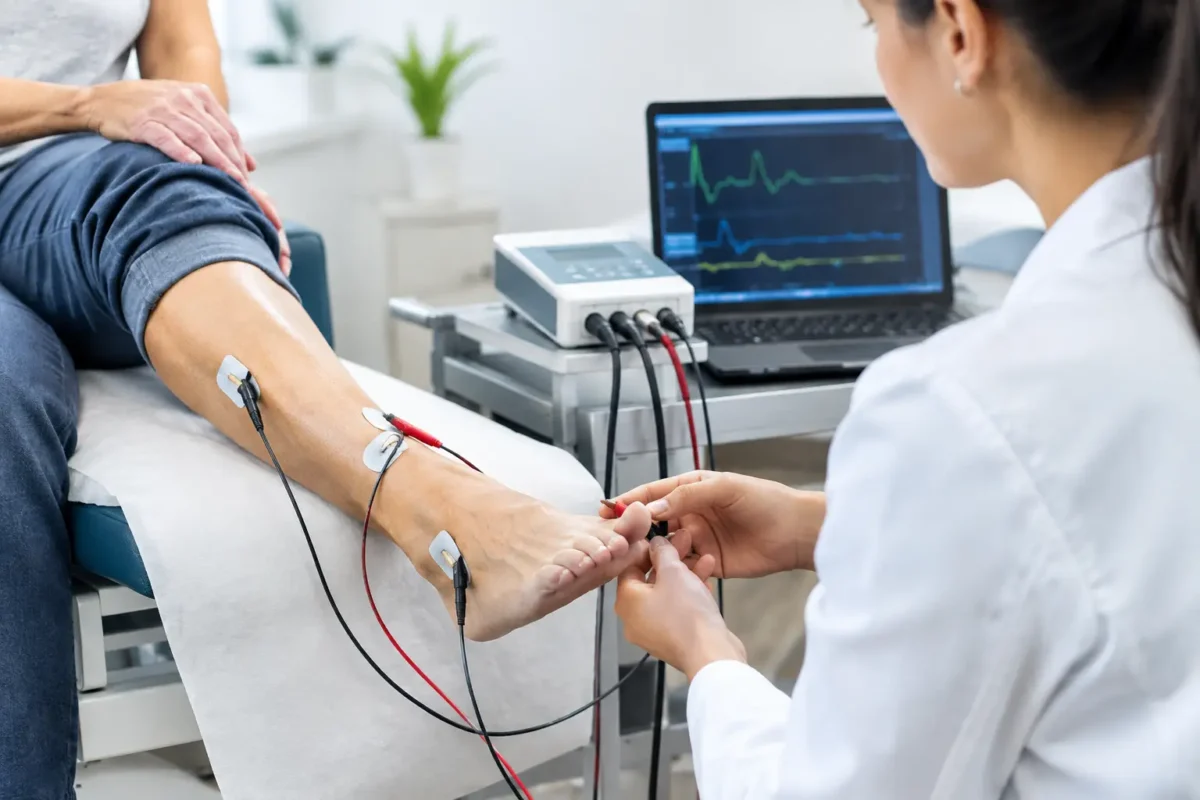
Nerve conduction studies, often performed with electromyography or EMG, are among the best diagnostic tests for neuropathy when symptoms involve large sensory or motor nerves. These outpatient tests measure how quickly and how strongly electrical signals travel through a nerve.
During a nerve conduction study, small electrodes are placed on the skin and a brief electrical pulse stimulates the nerve. The sensation can be uncomfortable, but it is typically short-lived. EMG uses a very thin needle electrode to assess electrical activity in selected muscles. Together, these tests can help determine whether nerve damage is present, whether it is mainly affecting the nerve’s insulating covering or the nerve fibers themselves, and how widespread it may be.
These tests can also help separate peripheral neuropathy from conditions such as radiculopathy, where a nerve root is irritated or compressed in the neck or low back. That distinction changes treatment. Spine-directed care may help a compressed nerve root, while metabolic or systemic neuropathy calls for a different plan.
EMG and nerve conduction studies have limits. They may be normal in early neuropathy or in small fiber neuropathy, which affects tiny pain- and temperature-sensing nerve fibers. A normal result does not automatically mean symptoms are not real or that further evaluation is unnecessary.
Skin biopsy for suspected small fiber neuropathy
When burning pain, sensitivity to light touch, or altered temperature sensation is present but standard nerve testing is normal, a skin biopsy may be considered. This minimally invasive test uses a small sample of skin, often from the lower leg, to measure the density of small nerve fibers.
A reduced nerve fiber density can support a diagnosis of small fiber neuropathy. The procedure is quick and usually performed with local anesthetic, though results may take time because the sample must be processed and interpreted in a specialized laboratory.
Skin biopsy is not needed for every patient with tingling or foot pain. It is most valuable when the symptom pattern strongly suggests small fiber involvement and the answer would affect treatment decisions or the search for an underlying cause.
Autonomic testing when body functions are affected
Some forms of neuropathy affect autonomic nerves, which control functions that occur without conscious effort. Symptoms can include dizziness when standing, unusual sweating, constipation or diarrhea, difficulty regulating body temperature, or changes in heart rate.
Autonomic testing may evaluate blood pressure and heart rate changes with position, sweat production, breathing responses, or other nerve-controlled functions. These studies are typically ordered when symptoms point beyond sensation and muscle control. They can help clarify whether autonomic nerve involvement is present and guide strategies to improve safety and daily comfort.
For example, a patient who feels lightheaded after standing may need evaluation for blood pressure changes, medication effects, hydration issues, heart concerns, and autonomic dysfunction. Testing should consider the full picture rather than assuming every symptom has one cause.
When imaging is useful – and when it is not
MRI, CT scans, and ultrasound do not diagnose most generalized neuropathies directly. However, imaging can be very useful when a clinician suspects a structural issue such as a herniated disc, spinal stenosis, a nerve entrapment, a mass, or trauma-related nerve injury.
An MRI of the lumbar spine may be appropriate for new weakness, shooting pain down one leg, or symptoms that align with a compressed nerve root. Ultrasound can sometimes show swelling or compression of superficial nerves, including at the wrist or elbow. Imaging is most effective when it answers a specific clinical question, not as a routine substitute for a neurologic examination or nerve testing.
Less common tests: genetic studies and nerve biopsy
Genetic testing may be appropriate when neuropathy begins at a young age, runs in families, or has features suggesting an inherited condition. The results can provide clarity for patients and relatives, although they do not always change immediate treatment.
Nerve biopsy is rarely needed. Because it is invasive and can leave lasting numbness at the biopsy site, it is generally reserved for unusual situations, such as suspected vasculitis, amyloidosis, or another condition where tissue confirmation would meaningfully change care.
What a coordinated diagnosis can change
Neuropathy testing is not about collecting results. It is about connecting symptoms to a cause and building a plan that protects function. That may include managing diabetes or nutritional issues, adjusting medications, treating a compressed nerve, improving balance and strength through physical therapy, addressing pain with appropriate non-opioid options, or coordinating specialty care when needed.
At Denville Medical Associates, an integrated evaluation can be particularly valuable when neuropathy symptoms overlap with back pain, neck pain, joint conditions, injury recovery, or changes in mobility. Communication among clinicians and rehabilitation providers helps keep the plan focused and avoids sending patients through disconnected appointments.
Seek timely medical evaluation for progressive weakness, frequent falls, rapidly spreading numbness, new bowel or bladder changes, severe back or neck pain with neurologic symptoms, or symptoms that begin suddenly. The right test is the one that answers the next meaningful question – and helps you move toward safer, more comfortable daily life.